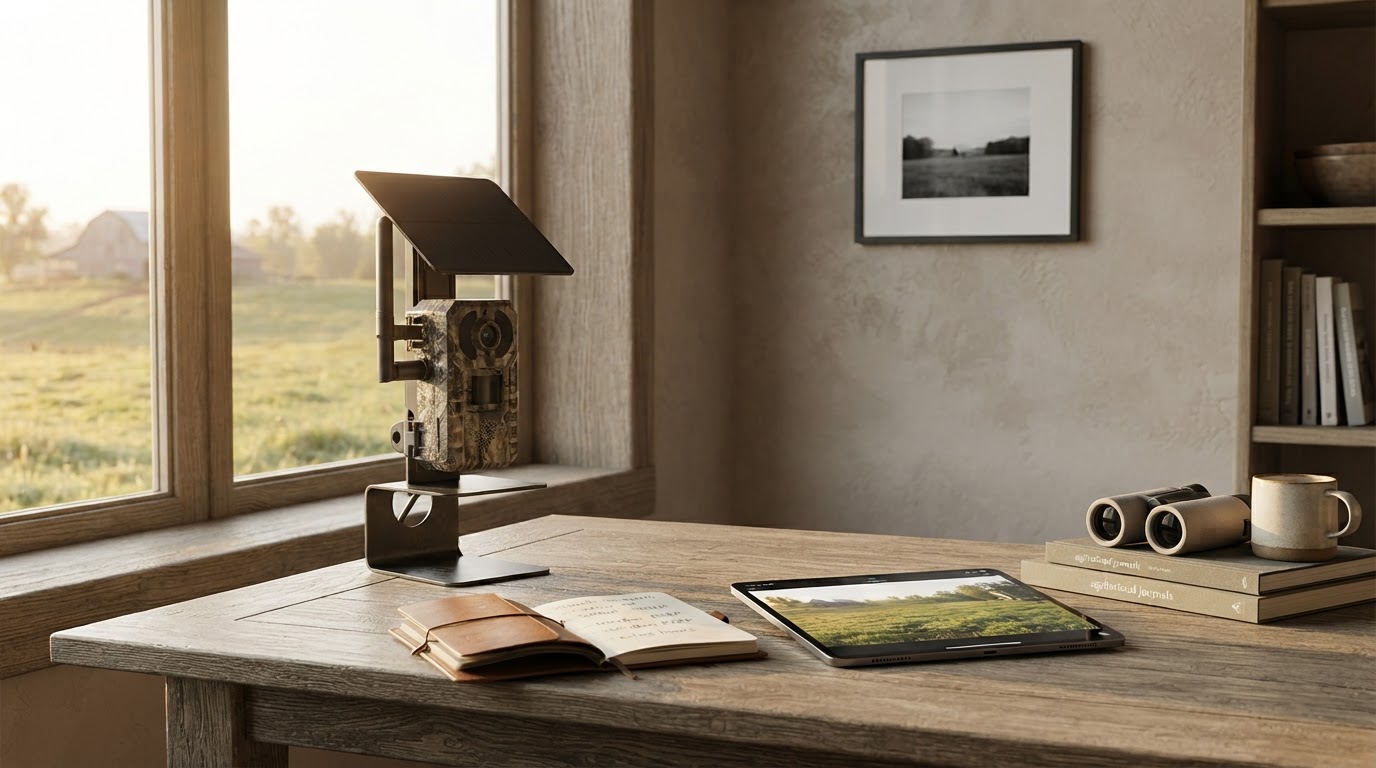
Can a Solar Cellular Camera provide reliable remote access?
 Maya ChenContributing Editor
September 14, 2026 — A Solar Cellular Camera provides reliable remote access if the site maintains a minimum -100 dBm RSRP signal strength and receives at least four hours of peak sunlight daily, though performance degrades significantly during sustained cloud cover. Rural property owners and agricultural managers utilize these systems to monitor livestock and equipment in areas where traditional Wi-Fi infrastructure is non-existent. The shift toward standalone 4G LTE hardware addresses the critical gap between passive recording and real-time situational awareness.
Does cellular latency compromise remote farm monitoring?
The conventional wisdom says that cellular cameras are too slow for real-time security, but modern 4G LTE modules have reduced trigger-to-app latency to under two seconds in optimal conditions. Here's the part nobody talks about: the bottleneck is rarely the camera hardware itself, but rather the upload speed of the local cell tower, which can fluctuate by 400% depending on regional network congestion. According to Reolink, specialized farm security cameras utilize 4G LTE to bypass the need for local network infrastructure, but users must account for data caps that can throttle video quality once a monthly threshold is reached. Run the math: a high-definition stream consumes approximately 2GB of data per hour of active viewing; without an unlimited data plan, "remote access" becomes a luxury rather than a persistent utility. I'll change my mind when satellite-linked units achieve the same price-per-gigabyte parity as terrestrial LTE.
Can solar power sustain 24/7 remote connectivity?
Standard solar-integrated units cannot support continuous 24/7 live streaming without a massive increase in battery capacity, as the power draw of an active LTE modem exceeds the typical 5-watt panel output. Most systems, such as the eufy 4G LTE Cam S330, are designed as event-based triggers to preserve energy for long-term operation in off-grid environments. While eufy notes these devices are wire-free and compact for easy placement, their primary function is motion-activated recording rather than a constant live feed. Effective deployment requires a strategic balance between PIR (Passive Infrared) sensitivity and battery health. If a sensor is triggered by wind-blown vegetation fifty times a day, the battery will deplete faster than the solar panel can recover the charge, even in high-sunlight regions. For a successful installation, users should follow a 5-Step Solar Cellular Camera Farm Deployment to ensure the hardware is positioned for maximum solar gain and minimal false triggers.
Quick answers
Q: What happens to remote access when the 4G signal is weak? A: The Solar Cellular Camera will typically downscale video resolution to 720p or lower to maintain the connection, or it may fail to initialize the live stream entirely if the signal drops below -110 dBm. High-gain external antennas are often required in rural valleys to maintain a stable link.
Q: Are there specific brands recommended for community-vetted farm security? A: In enthusiast communities like those found on Facebook, users frequently cite Tapo, AOSU, and Wuuk as reliable options for farm security due to their integrated motion detection and two-way audio features. These brands are often preferred for their balance of software stability and weather resistance.
Q: How does a SIM card impact the camera's remote functionality? A: The solar powered security camera with sim card acts as its own gateway, allowing users to access settings and footage via a smartphone app from any location with internet. This eliminates the 300-foot range limitation common with standard Wi-Fi security systems.
Q: Is it possible to use these cameras in areas with heavy tree cover? A: Reliable operation in forested areas requires deploying solar cellular camera systems in remote areas using detached solar panels mounted on poles or clearings up to 15 feet away from the camera body. Without direct sunlight, the internal battery will typically fail within 3 to 7 days of active use.
Learn more about Solar Cellular Camera at https://solarcellularcamera.com.
Sources
- Farm Security Cameras for Rural Properties | Reolink US
- Farm Security Cameras––How to Select the Right One - eufy US
- Recommendations for farm security camera systems? - Facebook